
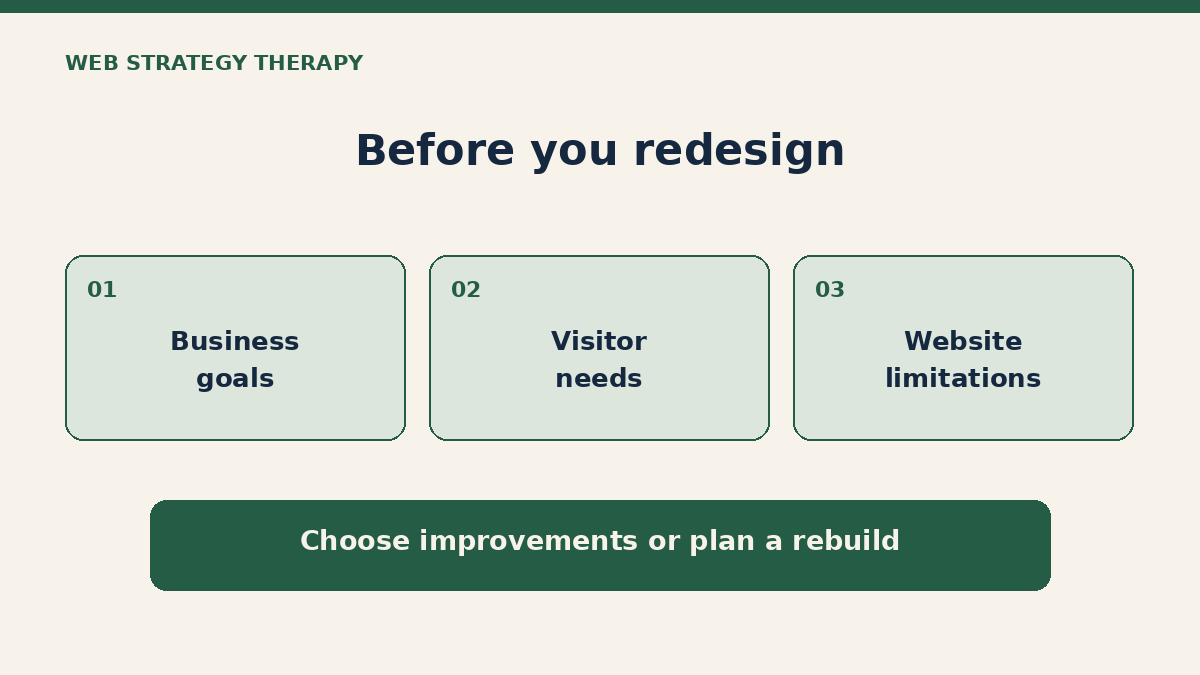
“We need a new website” often starts as a reasonable response to frustration.
The site looks dated. Someone can’t find an important page. Updating content feels difficult. Your team has a list of things they want to change, and starting over sounds easier than untangling what already exists.
A redesign may be the right decision. But before you commit to it, I would ask a more specific question: What do you need the next website to do that this one does not?
That answer gives you a better foundation for deciding whether to improve, restructure, or rebuild.
Start with a problem you can describe
“The website isn’t working” is a useful opening statement. It is not yet a clear project brief.
Try describing the frustration in terms of a person and a task. Can a prospective customer understand your services? Can an existing customer find the information they need? Can your team update a key page without a complicated workaround?
For example, “Our service pages feel confusing” could mean several things. The menu labels may be unclear. The pages may describe your internal departments instead of customer needs. The next step may be missing. The information may simply be out of date.
Those problems lead to different kinds of work. Identifying the actual obstacle helps you avoid buying a solution before you have named the need.
Separate appearance from structure and function
A visual refresh can make a website feel more current, but it does not automatically resolve confusing content or an unclear visitor journey.
I would look at three areas separately:
- Content and direction: Is the information accurate, useful, and connected to what visitors need?
- Structure and experience: Can people find the right information and complete important tasks?
- Platform and management: Can the website support the required features and can your team maintain it?
You may discover that the foundation is usable and the main work is content and organization. Or you may find structural and technical limitations that make a larger project more sensible.
The point is to understand what each part of the problem requires.
Identify which limitations are real
A team may say the platform cannot do something when the current implementation simply does not support it. The reverse can happen too: a feature may be technically possible but expensive or difficult to maintain.
Before choosing a new platform, ask your developer to explain the limitation and the available options in plain language. What would it take to change? What ongoing work would it create? Does an integration or existing requirement affect the answer?
Independent strategy can help frame those questions. Technical feasibility still needs input from the people who understand the implementation.
Consider what you would carry into a redesign
A rebuild will still need decisions about content, approvals, responsibilities, and priorities.
If no one knows which department owns the service information, that question will follow you into the new site. If every stakeholder wants a different navigation structure, a new design will not settle the disagreement by itself.
Before rebuilding, decide who represents each audience, who can approve the work, and what content needs to be created or reviewed. Planning those responsibilities makes the proposed project more concrete.
Use a small decision worksheet
For each major concern, write down:
- The visitor or team member affected.
- The task they are trying to complete.
- What gets in the way.
- The evidence you have, such as recurring questions, observed difficulties, or available analytics.
- Whether the fix appears to involve content, structure, design, technology, or management.
- What still needs investigation.
You do not need a perfect answer in every column. The gaps show you what to ask next.
For a hypothetical business with unclear service pages but a manageable platform, content and navigation improvements might be a useful first step. For one whose required customer journey cannot be supported by the current setup, a redesign discussion may be more justified.
Know what would make a redesign worthwhile
A redesign deserves a clear explanation of the improvement you expect to make. That might be a more usable service journey, support for a needed integration, easier content management, or a structure that reflects how the business now operates.
Define how you will assess those improvements. Depending on the goal, that could involve task testing, successful inquiries, content accuracy, or the time required to make routine updates.
Then plan the transition. Content review, redirects, analytics continuity, and launch checks deserve attention alongside design. The appropriate details depend on your site and project.
Decide with a clearer picture
You do not have to choose between leaving the website alone and replacing everything. There may be a practical sequence: investigate the problems, address useful improvements, and plan a rebuild if the evidence supports it.
If you need help understanding the current site, my Website Audit & Strategy Checkup is a starting point for that discussion. If a redesign is already on the horizon, Redesign Strategy can help turn the business needs into a clearer brief.
Tell me what prompted the conversation. We can start there.